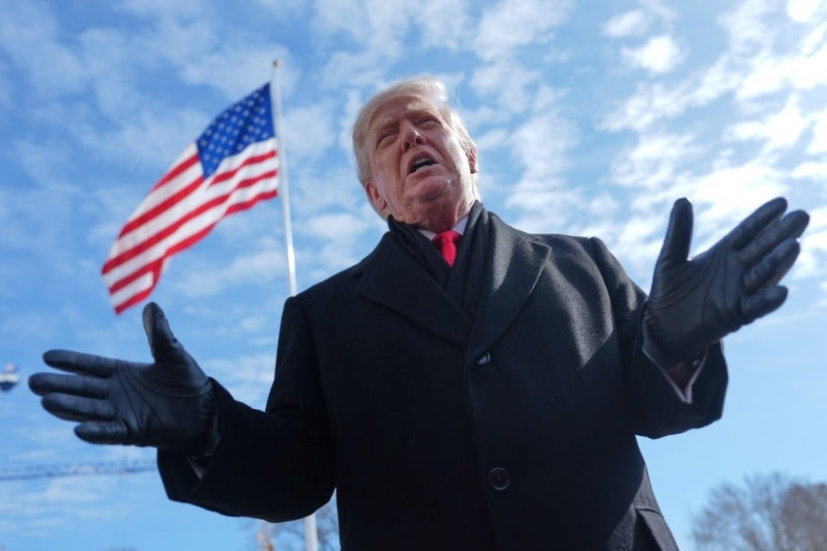
The global energy market and international diplomacy are currently focused on a single, narrow stretch of water: the Strait of Hormuz. Following a period of intense maritime tension and Iranian control, President Donald Trump has issued a definitive and optimistic prediction, stating that the strait will reopen “quite soon.” Speaking just ahead of a historic peace negotiation scheduled in Islamabad, Pakistan, the President’s remarks at Joint Base Andrews on April 10, 2026, have sent ripples through global capital markets and diplomatic circles. Trump’s stance is a calculated blend of economic pragmatism and a firm refusal to allow any nation to impose “tolls” on what he defines as international waters. This development marks a potential turning point in the long-standing standoff between Washington and Tehran, emphasizing the United States’ shift toward a policy of maritime freedom and nuclear non-proliferation.
The Economic Inevitability of Freedom of Navigation
President Trump’s assertion that the Strait of Hormuz will open “automatically” is grounded in a “follow the money” philosophy. He argued that the closure of the strait is ultimately more damaging to Iran than it is to the United States. Since the Iranian economy is heavily reliant on the revenue generated from transit and oil exports, a prolonged blockade is effectively a form of economic self-sabotage for the regime. Trump noted that if the U.S. were to simply “leave,” the strait would have to open because “if they don’t open it, they don’t make any money.”
This perspective highlights a significant shift in U.S. energy independence. Trump pointed out that the United States is no longer the primary user of this route, as domestic production and alternative supply chains have reduced American reliance on Middle Eastern crude. Instead, he signaled that other nations—those who directly benefit from the oil passing through Hormuz—should take a more active role in securing the passage. By framing the reopening as an economic necessity for Iran and a shared responsibility for the international community, Trump is positioning the U.S. as a facilitator of global trade rather than a direct combatant in every local skirmish.
International Law and the “Toll” Controversy
One of the most provocative aspects of recent Iranian policy has been the suggestion of collecting tolls or fees from vessels passing through the Strait of Hormuz. President Trump was unequivocal in his rejection of this idea, categorizing the strait as “international waters.” Under the United Nations Convention on the Law of the Sea (UNCLOS), the principle of “transit passage” allows ships to pass through international straits for the purpose of continuous and expeditious navigation.
Although the narrowest parts of the strait fall within the territorial waters of Iran and Oman, international law dictates that the coastal states cannot hamper or suspend this passage. Trump’s warning that “we won’t let that happen” serves as a deterrent against any Iranian attempt to monetize the chokepoint. By invoking the status of “international waters,” the President is signaling that any attempt to restrict or tax the passage of commercial vessels would be met with significant opposition, potentially involving a coalition of international partners who rely on the freedom of the seas for their own economic stability.
The Islamabad Summit: A New Diplomatic Frontier
The President’s comments come at a highly sensitive time, as Vice President J.D. Vance prepares to lead a high-level U.S. delegation to Islamabad, Pakistan, for talks with Iranian representatives. This summit is seen as a “huge mission,” aimed at formalizing a cessation of hostilities and establishing a new framework for regional security. The delegation includes key figures such as Jared Kushner and Middle East Envoy Steve Witkoff, representing a team that Trump describes as “excellent.”
The President expressed high confidence in his team, noting that the primary objective of these negotiations is clear: the total prohibition of nuclear weapons. Trump stated that “99% of our goal” is ensuring that Iran never attains nuclear capabilities. Interestingly, he also touched upon the concept of regime change, suggesting that while he believes significant internal shifts have already occurred within Iran, the U.S. objective remains focused on the nuclear issue rather than enforced political restructuring. This pragmatic approach—prioritizing nuclear security over political ideology—could provide the necessary room for a diplomatic breakthrough in Pakistan.
Military Reality and the Path to Peace
A recurring theme in the President’s recent rhetoric is the assertion that the Iranian military’s capacity for sustained conflict has been neutralized. Trump claimed that the U.S. has already dismantled much of Iran’s army, their weapons, and their manufacturing capabilities. This “position of strength” is the backdrop against which the U.S. is entering the negotiations. By claiming military superiority, the administration seeks to convince the Iranian leadership that diplomatic cooperation is their only viable path forward.
Trump’s dismissive response to whether there is a “Plan B” if the Islamabad talks fail—simply stating “I don’t need one”—reflects his belief that the current pressure campaign has left Iran with no other choice but to negotiate. If the strait opens “quite soon” as predicted, it will be viewed as a validation of this “Maximum Pressure 2.0” strategy. For the global community, the hope is that this confidence translates into a stable and open maritime environment, preventing a spike in global energy prices and ensuring that one of the world’s most critical trade routes remains free from the threat of blockade or extortion.
Conclusion: Global Implications of the Reopening
The reopening of the Strait of Hormuz is not just a regional win; it is a vital necessity for the global economy. As President Trump prepares for the results of the Vance-led mission in Pakistan, the world waits to see if the “automatic” opening he predicts will come to pass through diplomacy or continued economic pressure. By reasserting the strait’s status as international waters and focusing on a nuclear-free future, the administration is attempting to redraw the map of Middle Eastern relations. If successful, this could lead to a significant de-escalation of tensions, allowing global trade to flow without the shadow of a “toll” or a “blockade” looming over the horizon. The next few days in Islamabad will likely determine if Trump’s prediction of a “quite soon” reopening becomes a reality.